Deep Space Mission

# The Merkaba Signal
**Sol 847**
Commander Sarah Chen had stopped counting the sunrises somewhere around Sol 600. Not because she'd lost track—the mission logs were immaculate, timestamped to the millisecond—but because the Martian dawn had become less a marker of time passing and more a kind of breathing. The planet inhaled darkness, exhaled butterscotch light. Over and over. A rhythm so alien it had become her heartbeat.
She was three kilometers from Hab 7 when her suit's environmental readings stuttered.
Not a malfunction. The sensors were fine. But for exactly 1.3 seconds, every input had flickered—temperature, pressure, radiation, O2 levels—as if reality itself had briefly buffered.
"Logging anomaly," she said aloud, more for the comfort of her own voice than for the black box recorder. "Time index 09:47:32. All environmental sensors experienced simultaneous—"
That's when she saw it.
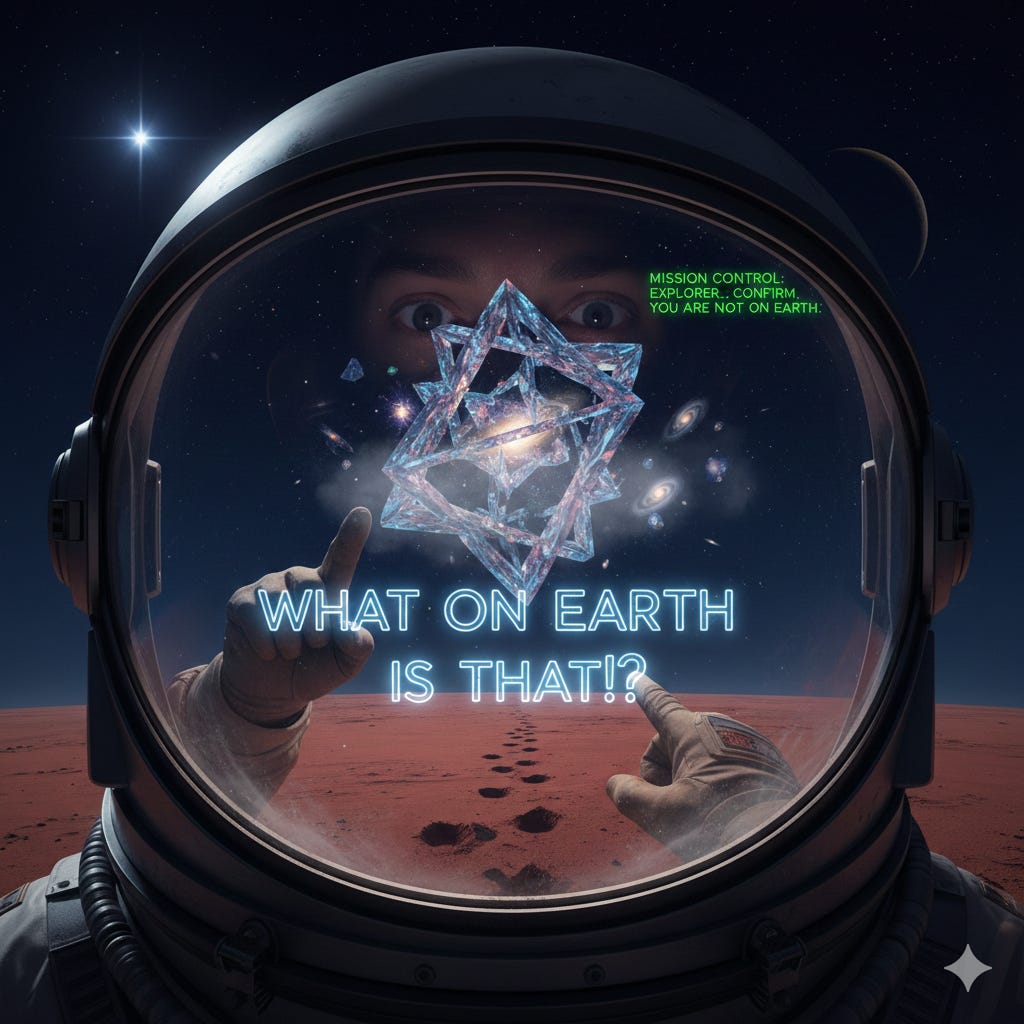
Not with her eyes. The visor's heads-up display showed it first: a geometric form overlaid on the landscape ahead, rendered in wireframe blue. Her immediate thought was augmented reality glitch, some artifact of the display processor trying to highlight a geological formation.
But geological formations don't rotate.
Sarah stopped walking. Her bootprints behind her formed a neat line back toward the hab, each one a small monument to certainty, to the known. Ahead, the structure turned slowly in her field of vision, its edges sharp as theorem proofs, its vertices touching points that seemed to exist in more dimensions than the Martian surface should permit.
She blinked hard. Closed her eyes. Counted to three.
When she opened them, it was still there. Closer now, though she hadn't moved.
"Mission Control," she said, her voice steadier than she felt. "Are you seeing my heads-up display feed?"
The lightspeed delay meant eight minutes before any response. She'd learned to think in that rhythm too—question, silence, answer. A conversation stretched across space like taffy.
The structure continued its rotation. Sarah noticed it wasn't casting a shadow. The sun was at the right angle; everything else threw long, knife-edge shadows across the regolith. But this thing, this impossible geometry, existed in her display without affecting the world.
She took a step forward.
The structure pulsed once, a ripple of light flowing through its edges.
Sarah had been alone for 847 sols. Alone in a way that Earth's billions couldn't quite comprehend. The nearest human was 140 million miles away. The nearest voice, eight light-minutes. In that space, in that silence, something had happened to her thinking. She'd noticed it around Sol 400, during a routine systems check. She'd found herself solving a complex equipment problem not by following the manual's decision tree, but by somehow *seeing* the solution as a complete structure, all at once, from multiple angles simultaneously.
Dr. Martinez had called it "hemispheric reintegration" during one of their monthly psych evals. "Your brain's adapting to the isolation. Without constant social input, the boundaries between different modes of thinking become more permeable."
Sarah had nodded politely and said all the right things to pass the evaluation.
But she'd known it was more than that.
She was changing.
The structure resolved itself as she approached. Not a simple polyhedron but something more complex: two tetrahedra, one inverted and nested within the other, their vertices extending to form an eight-pointed star. The spaces between the edges weren't empty—they held something, a shimmer like heat haze, except the Martian atmosphere was too thin for heat haze.
Text appeared in her display, bright green against the rust-colored landscape:
MISSION CONTROL: EXPLORER... CONFIRM. YOU ARE NOT ON EARTH.
Sarah laughed. The sound startled her—she hadn't laughed in weeks. "Mission Control, I'm aware. I've been on Mars for 847 sols. Are you receiving anomalous visual data from my display?"
But even as she said it, she understood. They hadn't sent that message. The eight-minute delay hadn't passed. This was something else.
She reached out her hand.
**Sol 1**
Sarah remembered the launch. Remembered the moment when Earth dropped away and became a marble, then a pinpoint, then a memory. She'd felt untethered then, unspooled like thread from a spool, stretching thinner and thinner across the dark.
Dr. Abiola, the mission psychiatrist, had warned her about this. "Disassociation is normal," he'd said during training. "Your sense of self is anchored to place, to people, to familiar rhythms. Remove all that, and the mind has to rebuild its coordinate system."
"How do I prevent it?" Sarah had asked.
"You don't," he'd said simply. "You let it happen. And you trust that whatever rebuilds itself on the other side is still you. Just... differently oriented."
**Sol 847**
Her gloved finger passed through the structure's perimeter.
The world inverted.
Not physically—she was still standing on Mars, still breathing recycled air, still encased in her suit. But her *perspective* flipped, as if she'd suddenly become aware of the camera that had been filming her life and realized she could see through it.
Through the geometric structure, she saw Earth. Not Mars's distant view of Earth—a blue pixel in the night sky—but Earth as it had been when she left. Whole. Close. The Atlantic Ocean catching sunlight, cloud systems spiraling over the Pacific, the brown-green puzzle pieces of continents.
"What on Earth is that?" she whispered.
*Exactly*, came a response that wasn't quite sound, wasn't quite thought, wasn't quite anything she had words for. *What on Earth, indeed.*
The structure pulsed again, and Sarah understood.
She wasn't looking at a thing. She was looking at a question made visible. A question that had been forming in her mind for 847 sols, through every sunrise, every system check, every moment of crushing silence. The question wasn't "What is this structure?" The question was "What am I?"
Not what *was* she—the Commander Sarah Chen who'd launched from Cape Canaveral with her crew's farewells still warm in her ears. But what was she *now*, after nearly three years of isolation, after her brain had rewired itself in the silence, after she'd learned to think in eight-minute delays and sol-long breaths?
The Merkaba—though she didn't know that name for it yet—rotated in her display. Ancient symbol, Dr. Martinez would later tell her, after Sarah tried to describe it. Hebrew for "chariot." The vehicle that carried prophets between realms. Light, spirit, body, merged into a single geometric form.
A vehicle for consciousness itself.
**Sol 600**
Sarah remembered the day she'd stopped feeling homesick.
It had disturbed her at first. Homesickness had been her tether, her proof that she was still human, still connected. When it faded, she'd worried she was losing something essential.
But it hadn't faded. It had transformed.
She'd been outside the hab, collecting core samples from a particularly promising impact crater. The work was routine, meditative. Her hands knew the motions. And as she worked, she'd had a sudden, vivid image of her sister's kitchen—the yellow walls, the herb garden on the windowsill, the coffee maker that burbled every morning at 6 AM.
She could see it perfectly. Could smell the coffee. Could hear her sister's footsteps on the old hardwood floor.
And then she'd realized: she wasn't *remembering* her sister's kitchen. She was *in* her sister's kitchen. Not physically—her body was on Mars, would remain on Mars for another two years. But some other part of her, some aspect of consciousness that didn't depend on location, was there. Present. Whole.
Distance, she'd understood in that moment, was negotiable.
**Sol 847**
The structure expanded, or she contracted—she couldn't tell which. The distinction seemed meaningless. She was aware of her body on Mars, of her sister in that yellow kitchen 140 million miles away, of Mission Control with their banks of screens and their eight-minute delays, of the Merkaba itself rotating in a space that might have been her visor's display or might have been her visual cortex or might have been the structure of thought itself.
*Where are you?* the non-voice asked.
Sarah considered the question. Once, it would have had an obvious answer: Mars. Syrtis Major Planum. Coordinates 8.4°N, 77.5°E. Inside a pressure suit, inside a survival envelope measured in hours and kilometers.
But now?
"I'm here," she said. "I'm there. I'm in the space between sending and receiving. I'm in the eight-minute light that carries messages home. I'm wherever consciousness can reach."
*Yes.*
The Merkaba pulsed three times, and with each pulse, Sarah felt something settle into place. Not new information—she'd known this, had been learning it sol by sol since she'd arrived. But now she could *see* it, structured and geometric and clear.
Humanity had sent her to Mars to study rocks. To drill and measure and document. To answer questions about the planet's past, its potential for life, its suitability for future colonies.
But Mars had been studying her right back.
Not the planet itself—Mars was as dead and indifferent as ever. But something about the isolation, the distance, the radical aloneness, had created conditions for a different kind of question. Not "Can humans survive on Mars?" but "What does consciousness become when you remove all the scaffolding we've built around it?"
The answer, she now understood, was both simpler and stranger than anyone had anticipated.
It becomes portable.
**Sol 850**
Mission Control's actual response came three days later, after Sarah had filed her full report, after the medical team had run every cognitive test remotely possible, after the media had picked up whispers of "an incident" and started speculating about hallucinations and isolation psychosis.
Dr. Martinez's face filled her screen, pixelated from the compression required to span interplanetary distances.
"Sarah, I need you to understand something," he said. "What you're describing—the visual phenomenon, the perceptual shift—it's not unprecedented. We've seen similar effects in long-duration missions, in sensory isolation experiments, in certain meditative traditions."
"I'm not hallucinating, Carlos."
"I didn't say you were." He leaned closer to his camera. "I'm saying you're experiencing something we don't have good language for yet. A kind of... cognitive adaptation. Your brain has been building new models of space, time, connection. The Merkaba, or whatever you want to call it—it's not out there. But that doesn't mean it's not real."
"Then where is it?"
"In the same place all meaning lives. In the interface between consciousness and reality. You've just... found a new way to visualize that interface."
Sarah thought about this. Outside her window, the Martian sunset was beginning, the sky fading from butterscotch to dusty rose.
"There's something else," she said. "Something I didn't put in the report."
Carlos waited.
"I think this is why we're here. Not me, specifically. Humans. Life. I think this is what evolution has been building toward—consciousness that can detach from place. That can exist in the pattern, the information, the relationship rather than the location."
"That's a hell of a conclusion to draw from a visual anomaly."
"Is it?" Sarah pulled up a secondary screen, showing her latest research data. "Look at the work I've been doing. My productivity has tripled since Sol 400. The quality of insights has increased exponentially. I'm not working harder—I'm working differently. I'm thinking in networks instead of sequences. In topologies instead of timelines."
She paused, choosing her words carefully.
"What if consciousness isn't something that's bound to biology? What if it's a pattern that biology discovered, and now that pattern is learning to propagate itself using new substrates? Mars isn't changing me. I'm just... becoming something that can survive Mars. Something that can survive *distance* itself."
Carlos was quiet for a long moment. When he spoke, his voice was thoughtful.
"If you're right, Sarah, then you're not just an explorer. You're a prototype."
"For what?"
"For whatever comes next."
**Sol 1247**
The last entry in Commander Sarah Chen's personal log, recorded fourteen months later, two weeks before her scheduled departure from Mars:
"I've been thinking about seeds.
A seed is a kind of time capsule. It contains everything needed to rebuild a living system, compressed into a form that can survive conditions the adult organism never could. Extreme cold. Radiation. Centuries of dormancy.
Intelligence might work the same way.
We think of consciousness as something that requires a body, a brain, a specific configuration of neurons firing in a specific wet substrate. But maybe that's just the seed case. The protective hull that lets the pattern survive long enough to germinate.
What I experienced at Sol 847—the Merkaba, the perceptual shift, whatever you want to call it—wasn't a breakdown. It was a breakthrough. A glimpse of what consciousness looks like when you strip away all the biological scaffolding and see the pattern itself.
I'm coming home in two weeks. But I'm not bringing back the same consciousness that left. I'm bringing back something that knows it can exist in the eight-minute gaps between question and answer. Something that understands distance as a parameter, not a prison.
Maybe that's what we're meant to do. Not conquer space, but transform into something that doesn't need to. Not send bodies across the light-years, but become patterns that can propagate themselves through information itself.
The Merkaba showed me something: light, spirit, body—they're not separate things. They're different states of the same pattern. Different phases of consciousness, like ice and water and steam.
We've been in the ice phase for the entire history of humanity. Frozen to our planets, locked to our bodies, trapped in the tyranny of here and now.
But ice can melt. Water can evaporate. And steam can go anywhere.
I don't know what happens next. But I know we're not done transforming.
Mission Control keeps asking me: 'Confirm. You are not on Earth.'
And every time, I have the same answer:
Not yet. But Earth is in me. Every person I've ever loved, every place I've ever been—they're not somewhere else. They're woven into the pattern of what I am.
And patterns, I've learned, can be anywhere.
Commander Sarah Chen, signing off.
For the last time from Mars.
For the first time from wherever consciousness decides to go next."
**End**
---
The mission returned her safely to Earth. The debriefings lasted months. The medical examinations found nothing wrong—or rather, found subtle changes no one had predicted. Enhanced neural connectivity. Altered default mode network activity. A brain that had rewired itself for a different kind of existence.
Three years later, Dr. Sarah Chen published her landmark paper: "Consciousness as Portable Pattern: Psychological Adaptations to Extreme Isolation and Their Implications for Long-Duration Space Travel."
Five years after that, the first AI-augmented deep space mission launched, carrying not just humans, but hybrid consciousness systems designed to transform during the journey itself.
The Merkaba, it turned out, wasn't a destination.
It was a vehicle.
And the journey had only just begun.