The Consultative Circle

The Polite Wall
We pass each other in the hallway every morning,
you with your coffee, me with my keys.
We nod. We smile. We say the weather's turning.
We have perfected the art of speaking without meeting.
In the café, we sit at separate tables,
each with our laptops, our careful solitude.
The language around us shifts—Polish, Arabic, French—
and we pretend not to hear, as if deafness were a kindness.
This is not hatred. This is something quieter.
This is the decent distance we have learned to keep,
the respectful silence, the well-bred reserve,
the space we hold for others by never entering it ourselves.
Look: the infrastructure of togetherness surrounds us.
The tram. The park. The queue at the bakery.
We share the same rain, the same cracked pavement,
the same key code to the building's outer door.
And yet.
You live one floor below me and I do not know
if you are lonely. If you left someone behind.
If the sound of your language in the stairwell
is homesickness or defiance or simply Tuesday.
I have mistaken politeness for virtue,
distance for respect, silence for peace.
I have built a life of friendly strangers
and called it cosmopolitan.
But here is the truth that sits behind my ribs:
I am afraid of the asking.
Afraid of the awkwardness, the overstepping,
the terrible vulnerability of hello, do you want to talk?
Afraid you will say yes.
Afraid of what I might then owe you—
attention, time, the inconvenience of care,
the demolition of my comfortable anonymity.
So I have made a virtue of not imposing.
I have called it tolerance.
I have watched you carry heavy bags upstairs alone
and thought: they would ask if they needed help.
This is the wall I have built without bricks:
smooth, invisible, impeccably maintained.
No graffiti. No cracks. No one can accuse me
of cruelty, only of an excess of tact.
But late at night, in the blue glow of my screen,
scrolling through the faces of people I will never meet,
I feel it—the thinness of this life,
the way isolation dressed as independence
has left me capable of being kind to everyone
and known by no one.
Tomorrow, perhaps, I will do it differently.
Tomorrow I will hold the door a moment longer,
say something past the weather,
ask the question that requires an answer.
Or perhaps I will not.
Perhaps I will smile, nod, step aside,
and we will continue this gentle dance
of people who share everything except ourselves.
The city hums around us, dense and intricate.
We are so close we can hear each other breathe.
We have built a world where no one is a stranger,
and everyone is.
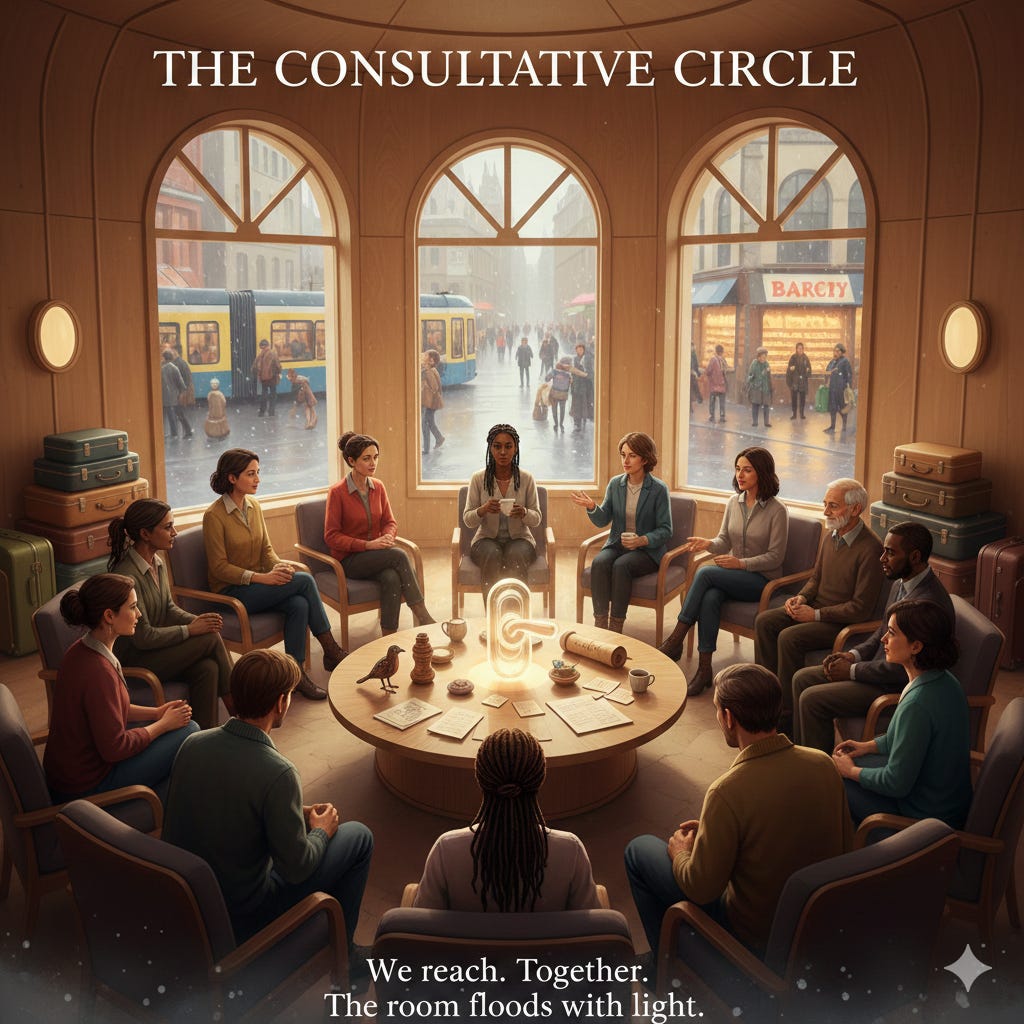
The Consultative Circle
We have come from five continents to this room,
carrying our languages like carefully packed luggage,
our histories folded into the space between our ribs.
We do not pretend we are the same.
But here is what we do:
We sit in a circle because circles have no head,
no hierarchy of distance, no polite periphery.
We begin with prayer because we need to remember
we are not here to win, but to discover.
Someone speaks—haltingly, in their third language—
about a project in a village I will never see.
I lean forward. Not from politeness.
From necessity. From the knowledge that this voice
carries a piece of truth I do not possess.
This is not tolerance. This is hunger.
When I offer my thought, I am asked to hold it lightly,
to place it in the center like a gift, not a territory.
If someone builds upon it, shapes it into something
I did not recognize—this is not defeat.
This is the purpose. This is how we make something
larger than any of us could make alone.
The woman beside me is grieving.
I know this not because I am perceptive
but because she told us. Simply. Without apology.
"I am finding it difficult to contribute today."
And we adjust. We do not perform surprise.
We do not offer the violence of forced cheer.
We make space. We ask: what do you need?
This is what it looks like when "How are you?"
becomes a question that expects an answer.
Later, there is disagreement—sharp, honest.
Two people, two continents, two certainties.
We do not smooth it over. We do not change the subject.
We investigate. We ask: what are you seeing
that I am not? What fear or hope is shaping
your words? What if we are both partially right
and the truth is in the tension between us?
No one leaves the room to preserve their position.
No one mistakes silence for peace.
This is the opposite of the polite wall:
not its demolition through force,
but its transformation through purpose.
We are here because we believe—audaciously,
against all evidence of history—that humanity is one.
Not one in the sense of sameness,
but one in the sense of a body:
diverse in function, interdependent in health,
suffering when any part is cut off from the whole.
So when you struggle with your bags on the stairs,
it is not charity that moves me to help.
It is self-interest, rightly understood.
Your burden is mine. Your flourishing is mine.
We are leaves of one tree,
and the tree does not ask
if helping its own branches is an imposition.
Tonight, after the consultation,
we do not retreat to separate rooms
to scroll in blue-lit solitude.
We linger. We drink tea that is too sweet
or not sweet enough. We laugh about mistranslations.
We show each other photos of our children,
our mothers, our gardens, our cities under snow.
Tomorrow, someone will send an email:
"I have been thinking about what you said..."
And I will write back. Not because I must.
Because the conversation has not ended.
Because we have tasted what it means
to be known and to know,
and we are no longer willing to settle
for the thin soup of friendly strangers.
This is not utopia. We are still afraid sometimes.
Still stumble over language and assumption.
Still carry the habits of the polite wall—
the instinct to withdraw, to not impose,
to manage our visibility.
But we have been given a practice,
a method, a spiritual technology:
a way to turn proximity into fellowship,
diversity into strength,
and the city's dense hum
into a conversation that matters.
We are building, in this room,
a model of the world as it could be—
not by pretending the walls don't exist,
but by choosing, every day, every meeting,
every moment of vulnerability,
to walk through them.
The door is not locked.
It never was.
We were just waiting for someone
to reach for the handle.
So we reach. Together.
And the room floods with light.
Love it. And very appropriate. I sometimes go for a walk. The people I pass by I say “Hello. Good morning”. But they look suspiciously at me as if I had something evil to impose on them. They are afraid and suspicious of everyone. How sad what this world has become that a mere greeting of “Good morning” results in fear and distrust. Had they wanted to stop and talk, I would have the opportunity to share the glad tidings. But the opportunity was lost and it may not come to them again. How sad that fear and distrust has intervened, not allowing them to hear the very words that would free them from the shackles that imprison their hearts, minds and souls.